Comparing Response Spectra
In order to perform comparisons between response spectra, the user must first indicate a reference spectrum by clicking on the Reference Spectrum button. Users can perform comparisons between acceleration, velocity and displacement spectra. There are three available options to define the reference spectrum:
Use current mean spectrum
This option will consider as the reference spectrum, the mean of
all the spectra computed in the Elastic/Inelastic
Spectra module.
Use
Code - Based spectrum
SeismoSpect allows users to create a target spectrum which is consistent
with the rules from a selection of National Codes. The National
Codes supported in SeismoSpect Include:
- Eurocode 8 spectrum: Spectrum following the rules prescribed in Eurocode 8. Whilst there is a pre-defined default value for the damping parameter, users can also introduce their own value by selecting the option custom and inserting a new value. It is also possible to control the type of spectrum (1 or 2), the class of the soil (A to E), the Peak Ground Acceleration (PGA) and the Importance Class (I to IV). The user is also given the choice of creating the design spectrum by introducing the Behavior Factor (q) and the Lower Bound Factor (β).Finally the specific spectra introduced in the National Annexes to Eurocode 8 may be automatically created. All the equations and values used on the calculation of this type of spectrum are present in the chapter 3 of the Eurocode 8.
- ASCE 41-17 Code spectrum (United States of America): Spectrum following the rules prescribed in the American Code for Seismic Evaluation and Retrofit of Existing Buildings (ASCE 41-17). Users can define the damping parameter, to one of the standard values or a custom value, the SXS and SXL spectral accelerations, the Soil Class (A to E) and the long period transition parameter. Details on the spectrum calculation methodology can be found in chapter 2.4 of the ASCE 41-17.
- ASCE 7-16 Code spectrum (United States of America): Spectrum following the rules prescribed in the American Code for the Minimum Design Loads and Associated Criteria for Buildings and Other Structures (ASCE 7-16). Users can define the SXS and SXL spectral accelerations, the Soil Class (A to E) and the long period transition parameter. Details on the spectrum calculation methodology can be found in section 11.4 of ASCE 7-16, but with the adaptations of the spectrum described in section 21.3 (see also section 11.4.8).
- UBC 1997 Code spectrum (United States of America): Spectrum following the rules prescribed in the 1997 Uniform Building Code (UBC 1997). Users can define the seismic zone and the soil class. Details on the spectrum calculation methodology can be found in section 1631 of the code.
- National Building Code of Canada 2015 (Canada): Design spectrum following the rules prescribed in the 2015 National Building Code of Canada. Users can define the PGA and the spectral acceleration at different periods (0.20, 0,50, 1.00, 2.00, 5.00 and 10.00 sec). Details on the spectrum calculation methodology can be found in section 4.1.8.4 of the code.
- NTC-18 - Italian Code spectrum: Spectrum following the rules prescribed in the Italian National Seismic Code (NTC-18). For the calculation of the elastic spectrum the user needs to define the damping parameter, the SXS and SXL spectral accelerations, the soil category (A to E), the Topographic Category (T1 to T4), the spectral amplification factor F0 and the Tc* period. The inelastic spectrum can be calculated after the Behavior Factor q is defined. All the equations and tables concerning the spectrum can be found in chapters 2.4, 3.2 and 7 of NTC-18.
- KANEPE - Greek Code spectrum: The Spectrum defined in the Greek Seismic Interventions Code (KANEPE). For the calculation of the elastic spectrum the user needs to define the damping parameter, the type of spectrum (1 or 2), the class of the soil (A to E), the Peak Ground Acceleration (PGA) and the Importance Class (I to IV). The user has the choice of creating the design spectrum by introducing the Behavior Factor (q) and the Lower Bound Factor (β). All the equations and values used on the calculation of this type of spectrum are present in the chapter 4.4.1.3 of the KANEPE.
- TBDY 2018 - Turkish Code spectrum: Spectrum following the rules defined in the Turkish Seismic Evaluation Building Code (TBDY). For the calculation of the elastic spectrum the user needs to define the damping parameter, the SXS and SXL spectral accelerations and the Soil Class (A to E). For the calculation of the design spectrum the user needs to define the Importance Class (BKS=1 to BKS=2) and the R and D Behavior Factors. The details and relationships for the spectrum calculation can be found in chapters 2, 3.1 and 4.2 of the TBDY.
- Spectrum for France: For the calculation of the elastic spectrum the user needs to define the damping parameter, the spectral acceleration, the seismicity zone (1 to 5) the Soil Type (A to E), the Importance class ( to IV) and whether the spectrum is calculated for an industrial building (existing or new) or not. Details for the spectrum calculation can be found in the French National Annex of Eurocode 8 and the French Official Regulatory Documents.
- NCSE-02 - Spanish Code spectrum: The spectrum defined in the Spanish Code for Earthquake Resistant Structures (NCSE - 02). For the elastic spectrum calculation the user needs to define the damping parameter, the Ground Type (A to E), the spectral acceleration, the Importance Class (I to II) and the Contribution Factor (K). For the calculation of the design spectrum the user needs to define the reduction factor for ductility. The details and relationships for the spectrum calculations can be found in chapters 2 and 3.7.3 of the NCSE-02.
- NTE E.030 2016 - Peruvian Code Spectrum: The spectrum defined in the Code E0.30 for Earthquake Resistant Design. For the elastic spectrum calculation the user needs to define the spectral acceleration, the seismicity zone (1 to 4) the Ground Type (S0 to S4) and the Use Factor. For the calculation of the design spectrum the user needs to define additionally the Basic Reduction Factor (Ro) and the Irregularity Factors Ia and Ip. The Spectrum is calculated for a 5% damping and details can be found in chapter 2 of the NTE E 030 2016.
- NCh 433 - Chilean Code spectrum: For the elastic spectrum calculation the user needs to define the Spectral Acceleration, The Seismicity Zone (1 to 3), the Soil Type (S0 to S4) and the Building Category (Class I to Class IV). For the inelastic spectrum the user needs to additionally define the Response modification factor (Ro), the Period with the Maximum Effective Modal Mass and the number of floors if the user wishes to calculate R* with equation (11) of the code instead of the default equation (10). The spectrum is computed for 5% damping. The details for the spectrum calculation can be found in chapters 4 and 6.3 of the Chilean Code (NCh 433) and the DS61 code of 2011.
- NSR10 - Colombian Code spectrum: The spectrum is defined in the Colombian Regulation for Earthquake Resistant Structures. For the elastic spectrum calculation the user needs to define the Peak Ground Acceleration and Velocity, the Soil Type (A to E) and the Importance Class (I to IV). For the calculation of the inelastic spectrum the user needs to additionally define the Basic Energy Dissipation Coefficient (Ro) and three Irregularity factors (Φa, Φp and Φr). The spectrum is calculated for 5% damping. The relationships and tables for the spectrum calculation can be found in chapters A.2 and A3.9 of the NSR10.
- NEC 2014 - Ecuadorean Code Spectrum: The spectrum is defined in the Ecuadorean Code for Earthquake Resistant Structures. For the elastic spectrum calculation the user needs to define the Soil Type (A to E) and the Amplification factor η. For the calculation of the inelastic spectrum the user needs to additionally define the Reduction Factor η. The spectrum is calculated for 5% damping. The relationships and tables for the spectrum calculation can be found in chapters 2 and 6.3.4 of the NEC 2014.
- Notification 1457-2000 - Japanese Code Spectrum: The elastic spectrum is calculated for 5% damping and the user needs to specify the spectral acceleration (Z factor) and the Soil Type (I to III). For the calculation of the inelastic spectrum the user needs to additionally define the Ds factor. The details for the spectrum calculation can be found in the Notification 1457-2000 and the Building Standard Law Enforcement Order.
- IS 1893 - Indian Code spectrum: The spectrum calculation follows the rules specified in the Indian Standard 1893 (Part 1) Criteria of Earthquake Design of Structures. For the calculation of the elastic spectrum the user needs to identify the Ground Type (A to C) and the Importance Class. For the calculation of the design spectrum the user needs to identify the Response Reduction Factor (R). Details on the calculation of the spectrum can be found in chapter 6.4 of the IS 1893.
- NBC 105 - Nepalese Code spectrum: The spectrum calculation rules are defined in the Nepal National Building Code (NBC 105). The design spectrum is calculated for 5% damping and the user needs to specify the Zoning Factor, the Ground Type (I to III), the Type of Building ((a) to (e)) and the Structural Performance Factor. Details on the spectrum calculation can be found in chapter 8 of the NBC 105.
- SP 2007 - Pakistani Code spectrum: The rules for the calculation of the spectrum are defined in the Building Code of Pakistan (SP 2007). The elastic spectrum is calculated for 5% spectrum and the user needs to define the Zoning Factor, the Seismicity Zone (1 to 4) and the Ground Type (SA to SE). The details for the spectrum calculation are found in section 5 of the SP2007.
- Spectrum for Portugal: For the calculation of the elastic spectrum the user needs to define the damping parameter, the spectral acceleration, the seismicity zone (1 to 5) the Soil Type (A to E), the Importance class ( to IV) and the Type of spectrum to be calculated (Type 1 or 2). For Type 2 Spectra the User should also define the Area of Portugal for which the spectrum is to be calculated. The user has the choice of creating the design spectrum by introducing the Behavior Factor (q) and the Lower Bound Factor (β). All the equations and values used on the calculation of this type of spectrum are present in the chapter 3 of the Eurocode 8 and the National Annex for Portugal
- Spectrum for Slovenia: For the calculation of the elastic spectrum the user needs to define the damping parameter, the spectral acceleration, the seismicity zone (1 to 5) the Soil Type (A to E), the Importance class ( to IV) and the Type of spectrum to be calculated (Type 1 or 2). The user has the choice of creating the design spectrum by introducing the Behavior Factor (q) and the Lower Bound Factor (β). All the equations and values used on the calculation of this type of spectrum are present in the chapter 3 of the Eurocode 8 and the National Annex for Slovenia.
- NZS 1170.5:2004 - New Zealand Code spectrum: For the calculation of the elastic spectrum with 5% damping the user needs to specify the Hazard factor, the Soil Type (A to E), the Return Period Factor, the Distance to the nearest major fault and the Annual Probability of Exceedance. The details for the spectrum calculation can be found in chapter 3 of the New Zealand Standard of 2004 and chapter 3 of the New Zealand Standard of 2002.
- MOC 2008 - Mexican Code spectrum: The spectrum defined in the Manual for the Design of Seismic Works. For the calculation of the elastic spectrum the user needs to define the damping value, the ground acceleration (a0,r) the Seismicity Zone (A to D), the Soil Type, The Importance Class and the Soil characteristics (Total Depth of Soil layer, wave propagation velocity, rock wave propagation velocity, soil special weight and rock special weight). For the calculation of the inelastic spectrum the user needs to additionally specify the Seismic Behavior Factor, the Overstrength Factor and the Redundancy Factor. Details on the spectrum calculation can be found in sections 3.1 and 3.3 of the MOC 2008.
- NMX-R-079-SCFI-2015 - Mexican Code spectrum: The spectrum defined in the Mexican Code for Schools and the Structural Security of the Educational Physical Infrastructure. For the calculation of the elastic spectrum the user needs to define the damping value, the ground acceleration (a0,r) the Seismicity Zone (A to D) and the Soil Type (I to III). For the calculation of the inelastic spectrum the user needs to additionally specify the Seismic Behavior Factor. Details on the spectrum calculation can be found in section 10 of the NMX-R-079-SCFI-2015.
- MOC 2015 - Mexican Code spectrum: The spectrum defined in the Manual for Design of Civil Works. For the calculation of the elastic spectrum the user needs to define the damping value, the ground acceleration (a0,r) the Seismicity Zone (A to D), the Soil Type (I to III), the Importance Class and the Response Factor. For the calculation of the inelastic spectrum the user needs to additionally specify the Seismic Behavior Factor, the Redundancy Factor and the Overstrength Factor. Details on the spectrum calculation can be found in sections 3.1 and 3.3 of the MOC 2015.
- NTC 2004 - Mexican Code spectrum: The spectrum defined in the Technical Codes on the Criteria and Loads for the Design of Structures published by the Government of the Federal District of the City of Mexico. For the calculation of the elastic spectrum with 5% damping the user needs to define the ground acceleration (a0) and the Soil Type (I to IIId). For the calculation of the inelastic spectrum the user needs to additionally specify the Seismic Behavior Factor. Details on the spectrum calculation can be found in sections 3 and 4 of the NTC-2004.
- CSCR 2010 - Costa Rican Code spectrum: The spectrum is defined in the Seismic Code of Costa Rica. For the calculation of the spectrum with the 5% damping the user needs to define the Effective Peak Ground Acceleration and the Seismicity Zone (I to IV), the Ground Type (S1 to S4), the Global Ductility Factor (1 for elastic spectrum and higher for inelastic spectrum) and the System Overstrength Factor. The details for the calculation of the spectrum are found in chapters 3 to 5 of the CSCR-2010.
- INPRES-CIRSOC 1991 - Argentinian Code spectrum: The spectrum is defined in the Argentinian Code for Earthquake Resistant Structures of 1991. For the calculation of the elastic spectrum the user needs to specify the damping parameter, the Maximum Ground Acceleration, the Seismicity Zone (0 to 4), the Ground Type (I to III) and The Importance Class (A0 to B). For the calculation of the inelastic spectrum the user needs to additionally specify the Global Ductility and the Risk Factor. The details and relationships on the spectrum calculation can be found in chapters 3 to 8 of the INPRES-CIRSOC 1991.
- INPRES-CIRSOC 2013 - Argentinian Code spectrum: The spectrum is defined in the Argentinian Code for Earthquake Resistant Structures of 2013. For the calculation of the elastic spectrum the user needs to specify the damping parameter, the Maximum Ground Acceleration, the Seismicity Zone (0 to 4), the Ground Type (Sa to Se) and The Importance Class (A0 to C). For the calculation of the inelastic spectrum the user needs to additionally specify the Global Ductility and the Risk Factor. The details and relationships on the spectrum calculation can be found in chapters 2 and 3 of the INPRES-CIRSOC 2013.
- Standard 2008 - Iranian Code spectrum: For the calculation of the elastic spectrum with 5% damping the user needs to specify the Peak Ground Acceleration, the Seismicity Zone (1 to 4) the Soil Type (1to4) and the Importance Class. For the calculation of the inelastic spectrum the user needs to also specify the Building Behavior Factor. Details and Relationships on the spectrum calculation can be found in chapters 1 and 2 of the Standard 2008.
- KDS 17 10 00 2018 - Korean Code spectrum: For the calculation of the elastic spectrum with 5% damping the user needs to specify the Zone Coefficient, the Seismicity Zone (I or II) the Ground Type (S1 to S5) and the Earthquake Average Reproduction Cycle (50 to 4800 years). Details and Relationships on the spectrum calculation can be found in chapter 4.2.1 of the KDS 17 10 00 2018.
- INDICATIV P 100-1/2013 - Romanian Code spectrum: For the calculation of the elastic spectrum the user needs to specify the damping value, the Terrain Acceleration and the Seismicity Zone (defined by the value of Tc in each zone). For the calculation of the inelastic spectrum the user needs to also specify the Behavior Factor. Details and Relationships on the spectrum calculation can be found in chapter 3 of the INDICATIV P 100-1/2013.
- AS 1170.4/2007 - Australian Code spectrum: For the calculation of the elastic spectrum with 5% damping the user needs to specify the Hazard Design Factor, the Ground Type (Ae to Ee) and the Annual Probability of Exceedance (1/2500 to 1/200). For the calculation of the inelastic spectrum the user needs to also specify the Structural Ductility Factor and the Structural Behavior Factor. Details and Relationships on the spectrum calculation can be found in sections 3, 4 and 5of the AS 1170.4/2007.
Use spectrum from loaded accelerogram
In this third option the user can select an accelerogram already
loaded onto the program and use the response spectrum from this
record as the reference spectrum. The parameters that were considered
to compute the spectral response (e.g. elastic or inelastic spectrum
and respective damping or ductility value) are the ones defined
in the Elastic/Inelastic Spectra
module.
Load spectrum from file
This option allows a user to load a spectral response saved in
a text file. SeismoSpect requires that the corresponding values
to be organized in two columns - periods and spectral acceleration
(Note: response spectra saved in SeismoSignal, SeismoMatch
or SeismoSpect are already adequately formatted). A second
window will be displayed where a user can specify which columns
contain the periods and the spectral acceleration and which rows
of the file should be considered.

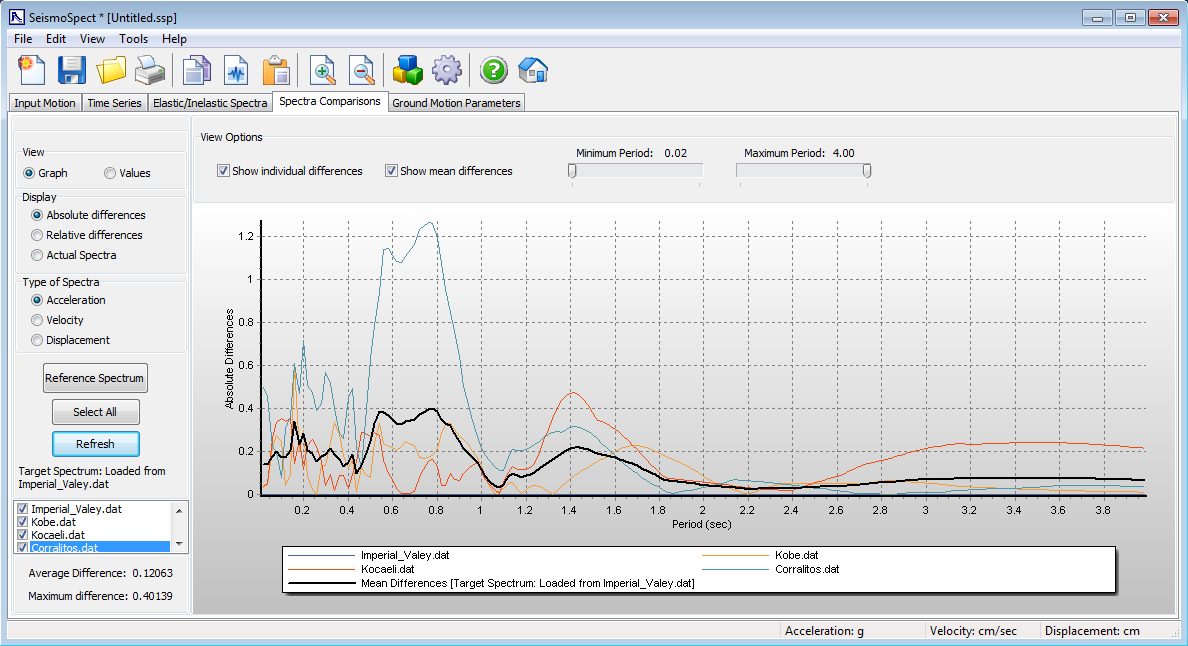
Once a reference spectrum has been defined, users can select the records whose response spectra are supposed to be compared with the previously defined reference spectrum. These differences might be presented in absolute or relative values and a user can toggle between viewing the results in charts or tables by using the check boxes on the upper left corner of the window. It is also possible to adjust the interval of periods to be considered by selecting a minimum and maximum period available on the upper panel. Every time a new combination of records is selected or a new reference spectrum is defined, it is necessary to press Refresh in order to compute the updated values (both tables and charts), as well as average and maximum differences.