Global Response Parameters
For pushover analysis four different kinds of global response parameters results can be output in this module; (i) structural displacements, (ii) forces and moments at supports, (iii) hysteretic curves and (iv) Code-based checks. Apart from the latter, all the other results are defined in the global system of coordinates, as illustrated in the figure below, where it is noted that rotation/moment variables defined with regards to a particular axis, refer always to the rotation/moment around, not along, that same axis.
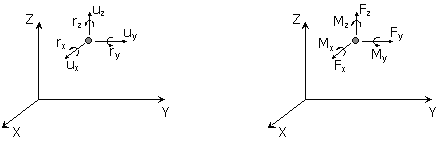
Note: The supports reactions should evidently be equal to the internal forces of the base elements that are connected to the foundation nodes. In other words, one would normally expect the values obtained in Forces and Moments at Supports to be identical to those given in the Element Action Effects for the elements connected to the foundations. However, some factors may actually lead to differences in these two response parameters, e.g. the member action effects are given in the local reference system of each element, whilst reactions at supports are provided in the global coordinates system. Hence, in those cases where large displacements/rotations are incurred by the structure, differences in element shears and support horizontal reactions may be observed.
These Global Response Parameters are briefly described hereafter:
Structural displacements
The user can obtain the displacement results of any given number of nodes including the control node, for any of the six global degrees-of-freedom. The possibility for relative displacement output is also available, as well as the choice of displaying in the graph the maximum, minimum and absolute maximum values.
Forces and Moments at Supports
Similarly to the structural deformations, the support forces and moments in every direction can be obtained for all restrained nodes. The possibility for outputting the total support force/moment in the specified direction, instead of individual support values, enables also the computation and plotting of total base shear values, for instance. Finally, the maximum, minimum and absolute maximum values may be displayed on the selected graph.
Note: Evidently, the total moment support reaction does not include overturning effects, consisting simply of the sum of moments at the structure's supports.
Hysteretic Curves
The user is able to specify a translational/rotational global degree-of-freedom to be plotted against the corresponding total base-shear/base-moment or load factor (pushover analysis). In static nonlinear analysis such a plot represents the structure's capacity curve. The possibility for relative displacement output is also available, as well as the choice of displaying in graph the maximum, minimum and absolute maximum values.
Code-based Checks
Here, it is possible for the user to display the Code-based Checks in every step of the analysis. Users may select the name of the check from the relevant drop-down menu, and the step of the analysis, and click on the Refresh button. The results can be displayed for all the structural members, or just for those members that have reached the selected check.